Why Industrial Ethernet Communication is the Foundation of Reliable Molten Metal Level Control
In any cast house, consistency is everything. The quality of the final product depends on dozens of variables held within precise tolerances, simultaneously, across every stage of the casting process. Among these, molten metal level control stands out as one of the most consequential. When the level drifts, the consequences reach far beyond a single casting.
The Cost of Instability
Inconsistent molten metal level is one of the most common root causes of casting defects. The reasons are well understood in the industry. When the level in a launder or mould fluctuates beyond acceptable limits, the filling rate changes. Turbulence increases. Oxide formation accelerates. Surface quality deteriorates. In DC casting operations, unstable levels during the critical filling phase can lead to cold shuts, porosity, or uneven grain structure throughout the ingot.
For operators on the floor, an unstable level demands constant attention. Manual adjustments introduce new variables. Each intervention, however skilled, carries a degree of uncertainty that an automated system does not. Over the course of a production run, these interventions accumulate. Process repeatability is compromised. The window for human error widens.
The economic consequences are tangible: increased scrap rates, higher energy consumption through unnecessary remelting, unplanned downtime, and reduced throughput. None of these outcomes are inevitable.
Why Communication Speed Determines Control Quality
Reliable level control depends on more than the accuracy of the sensor or the mechanical precision of the actuator. Those qualities matter, but they are rendered ineffective if the data transfer between them is slow or unreliable.
Consider what happens in practice. A laser camera sensor detects a deviation in the molten metal level. That measurement must travel through the communication interface to the control system, which processes the data, calculates the required correction, and sends a command to the actuator. The actuator then responds. From detection to correction, every millisecond of delay translates into additional process variation.
In traditional setups using analogue signal transmission or older serial communication protocols, that delay is a known limitation. The signal travels. The PLC reads it on its next scan cycle. The actuator receives its instruction on the following cycle. By the time the correction is made, the process has moved on. The control system is, in effect, always reacting to a past state of the process rather than its present one.
Industrial Ethernet changes this fundamentally.
How Industrial Ethernet Closes the Loop
Protocols such as PROFINET and EtherNet/IP are designed for deterministic, high-speed data exchange in industrial environments. Unlike analogue signals, which carry a single value at a fixed resolution, Industrial Ethernet transmits structured data packets with timestamps, status information, and diagnostic data, all in real time.
When a Precimeter sensor communicates via Industrial Ethernet, the level measurement is transferred directly to the PLC within a single network cycle, typically in the range of one to ten milliseconds depending on the configuration. The control system reacts immediately. The actuator receives its correction command without lag. The process remains stable.
This is not an incremental improvement. It is a structural change in how responsive the control loop can be. The faster and more reliably the data flows, the tighter the control. The tighter the control, the more consistent the cast house output.
The Integration Advantage
Beyond raw speed, Industrial Ethernet brings a further benefit that is increasingly important in modern cast house operations: seamless integration with existing automation infrastructure.
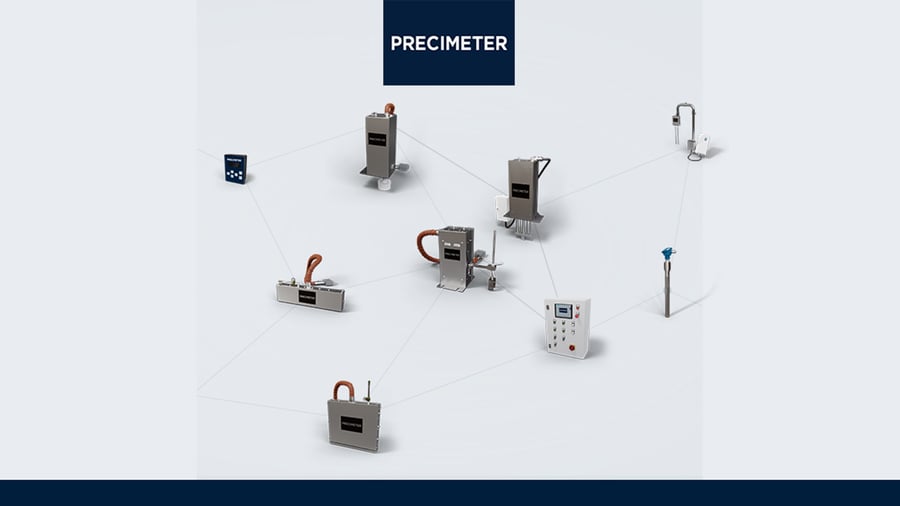
Most contemporary PLCs and SCADA systems are designed around Industrial Ethernet as the primary communication standard. When sensors and actuators speak the same protocol as the broader control network, integration is straightforward. There are no interface converters to maintain, no signal conditioning boxes to calibrate, and no analogue wiring to troubleshoot.
This matters practically. A cast house adding new sensors or upgrading actuators should be able to connect them to the existing network without redesigning the control architecture. Precimeter sensors and actuators support PROFINET, EtherNet/IP as standard or optional interfaces, meaning they can slot into most production environments without requiring significant additional engineering.
The result is a control system that scales as operations grow. A single sensor controlling a launder level today can be joined by additional sensors at the furnace tap out, at the mould level, and across the distribution system, all integrated into a unified control loop that manages the entire casting process from a single interface.
A Foundation for Further Automation
Connected cast house equipment is also the foundation on which further automation is built. The data generated by Industrial Ethernet-connected sensors and actuators, position values, level measurements, temperature readings, alarm states, flow corrections, does not simply serve the immediate control loop. It accumulates as a process record.
Plant engineers can analyse this data to identify patterns, refine casting recipes, schedule predictive maintenance, and optimise process parameters over time. The transition toward Industry 4.0 in aluminium production requires precisely this kind of structured, timestamped data flowing from the process floor into analysis tools. Cast houses that invest in connected equipment now are building the data infrastructure that will support continuous improvement for years ahead.
The Precimeter Approach
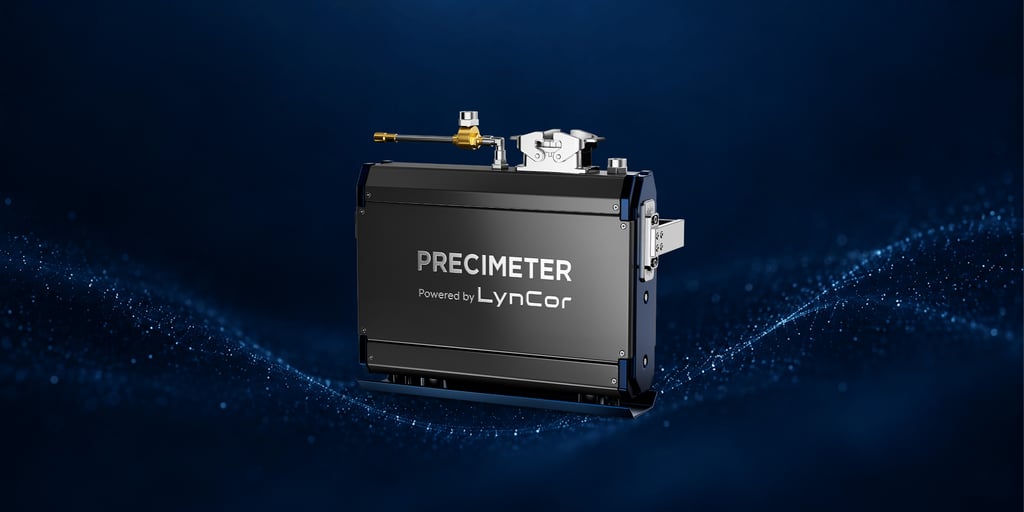
Precimeter sensors and actuators are designed with Industrial Ethernet integration as a standard consideration, not an afterthought. The ProH laser camera sensor family, the ProH Twin Delta for slab mould applications, the ProLAD for launder and furnace environments, and the full range of actuators, including the TXP-10 tap out, the PXP-2EM pin position, and the GXP-10 gate valve, all support PROFINET and EtherNet/IP.
This means that a complete level control solution, from sensor through actuator, controlled by an MLC-A1 single-point system or a customised MLC-ADV installation, can be built on a single communication protocol, integrated cleanly into the PLC architecture that already governs the rest of the production line.
For cast houses evaluating upgrades to their level control systems, the communication layer is where the investment in precision is either preserved or lost. A highly accurate sensor feeding data through a slow or unreliable interface cannot deliver the control quality the sensor itself is capable of. Industrial Ethernet removes that bottleneck.
Starting the Conversation
If stability in your casting process is a priority, and the communication architecture connecting your sensors and actuators to your control system has not been recently reviewed, it is worth examining whether the current setup is limiting the performance you are already paying for.
Precimeter works with cast houses at every stage of automation, from initial integration to full system upgrades, and can advise on the most appropriate communication configuration for your specific process and PLC environment.
Contact us at sales@precimeter.com to discuss your requirements.